CentoXome MOx Diagnosed Niemann-Pick Disease Type C1
Demonstrating the power of CENTOGENE’s multiomic approach for a fast and conclusive diagnosis


An ideal biomarker plays an essential role in the early diagnosis, prediction, and therapeutic monitoring of a specific disease, reflecting the burden of the disease for the patients.
Using a biomarker either as a diagnostic tool or in regular monitoring of the disease progression can be of high clinical value for the patients. Biomarkers can be used as a measure of the therapy efficacy and even as a guide for therapy dosage.
CENTOGENE offers rapid medical diagnosis of rare hereditary diseases through the broadest genetic testing portfolio combined with biomarker and enzymatic testing as well as best-in-class interpretation.

Monitoring response to treatment

Simplified logistics and analysis in dried blood spots (DBS) with CE-labeled filter card technology (CentoCard®)

High sensitivity and specificity

Short turnaround time

Guiding individualized treatment regimen for improved outcomes
Enzyme activity and biomarker assays can be used for disease diagnosis and novel drug development validation. Enzymes and biochemical biomarker often represent key functions in physiological process. Therefore, they are a powerful tool to reveals early signs of diseases or to streamline disease progress.

First step diagnosis of complex & multi-systemic metabolic diseases
In complex diseases and disease pathways, a genetic test alone typically can’t provide the information needed for a final diagnosis. Therefore, CENTOGENE has pioneered the combination of different tests, like biomarker and multi-biomarker patterns with clear recommendations for testing strategies1. These testing strategies offer you and your patients a faster, more reliable, and more complete solution – providing vital and time-sensitive answers when they matter the most.
| Testing | Strategy | CENTOGENE Portfolio |
|---|---|---|
| Biomarker | Biomarker testing for pre or post diagnosis | for the following diseases: Gaucher disease, Fabry disease, Niemann-Pick disease type A/B and type C, AADC deficiency. |
| Enzyme | Enzyme activity testing for pre or post diagnosis | for the following diseases: Gaucher disease, Fabry disease, Pompe disease, Hurler syndrome (MPS I), Hunter syndrome (MPS II), Maroteaux-Lamy syndrome (MPS VI), Morquio syndrome B (MPS IV B), Wolman disease, Sanfilippo syndrome B (MPS III B), Beta-mannosidosis, Fucosidosis, Sly syndrome (MPS VII), Tay-Sachs disease, Sandhoff disease, Schindler/Kanzaki disease, Santavuori-Haltia disease, Jansky-Bielschowsky disease |
| Multiomics Solutions | ||
| Genetic panel + biomarker / enzyme | Testing a comprehensive range of genes first, followed by biochemical testing1 | CentoMetabolic® MOx (~ 200 metabolic disorders) Also available in combination with WES or WGS, and additional RNA-seq. Fore more information please visit: Multiomic Solutions. |
Metabolic diseases are a group of rare, inherited diseases characterized by abnormal accumulation of different metabolites in the cells, leading to impaired functioning of the affected cellular organells.
A further subgroup, Lysosomal storage disorders (LSDs), collectively affect 1 in 5,000 live births, with Fabry and Gaucher disease being the most prevalent.2,3,4 It is estimated that every 20 minutes a child is born with an inherited LSD.
CENTOGENE has developed multiple specific biomarkers for certain LSDs with therapeutic options. For example, Lyso-Gb1 has been identified as the most effective biomarker for Gaucher disease.5 All analyses can be done from dried blood spots with CentoCard® and help with the early diagnosis, as well as disease progression and therapeutic monitoring of a specific disorder in the most effective manner.
| Enzyme Assay | Disease/Syndrome | Disease Type | Detection Method | Gene |
|---|---|---|---|---|
| beta-glucocerebrosidase | Gaucher disease | LSD | Fluorimetry | GBA |
| alpha-galactosidase | Fabry disease | LSD | Fluorimetry | GLA |
| alpha-glucosidase | Pompe disease | LSD | Fluorimetry | GAA |
| alpha-L-iduronidase | Hurler syndrome (MPS I) | LSD | Fluorimetry | IDUA |
| iduronate-2-sulfatase | Hunter syndrome (MPS II) | LSD | Fluorimetry | IDS |
| arylsulfatase B | Maroteaux-Lamy syndrome (MPS VI) | LSD | Fluorimetry | ARSB |
| beta-galactosidase | Morquio syndrome B (MPS IV B) | LSD | Tandem-MS | GLB1 |
| acid-lipase | Wolman disease | LSD | Tandem-MS | LIPA |
| alpha-N-acetylglucosaminidase | Sanfilippo syndrome B (MPS III B) | LSD | Fluorimetry | NAGLU |
| beta-mannosidase | Beta-mannosidosis | LSD | Fluorimetry | MANBA |
| alpha-fucosidase | Fucosidosis | LSD | Fluorimetry | FUCA1 |
| beta-glucuronidase | Sly syndrome (MPS VII) | LSD | Fluorimetry | GUSB |
| beta-hexosaminidase | Tay-Sachs disease | LSD | Fluorimetry | HEXA |
| total-hexosaminidase | Sandhoff disease | LSD | Fluorimetry | HEXB |
| alpha-N-acetylgalactosaminidase | Schindler/Kanzaki disease | LSD | Fluorimetry | NAGA |
| palmitoyl-protein-thioesterase | Santavuori-Haltia disease | NCL | Fluorimetry | PPT1 |
| tripeptidyl-peptidase | Jansky-Bielschowsky disease | NCL | Fluorimetry | TPP1 |
| Metabolic Biomarker | Disease/Syndrome | Disease Type | Detection Method | Gene |
|---|---|---|---|---|
| glucosylsphingosine (lyso-Gb1) | Gaucher disease | LSD | Tandem-MS | GBA, PSAP |
| lyso-ceramide trihexoside (lyso-Gb3) | Fabry disease | LSD | Tandem-MS | GLA, PSAP |
| lyso-SM-509 | Niemann-Pick disease type A/B and type C | LSD | Tandem-MS | SMPD1, NPC1, NPC2 |
| 3-O-methyldopa (3-OMD) | AADC deficiency | neurological | Tandem-MS | DDC |
Lyso-Gb1 has been identified as the most precise biomarker for Gaucher disease (GD)5. With a sensitivity and specificity of 100% (see below), it is the optimal biomarker for a sensitive and reliable diagnosis of GD. Evidence of patient data also proves that quantitation of this biomarker can serve as a direct indicator of disease burden and response to treatment for monitoring GD.5
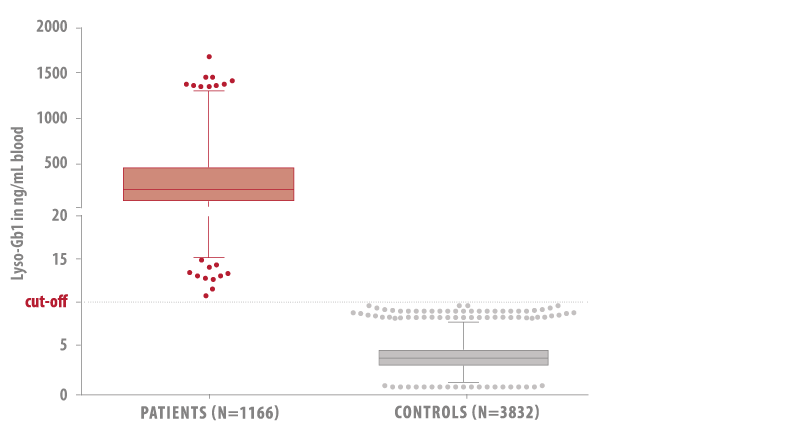
100% sensitivity and 100% specificity of Lyso-Gb1 leading to highest accuracy in patient identification for an optimal diagnosis.
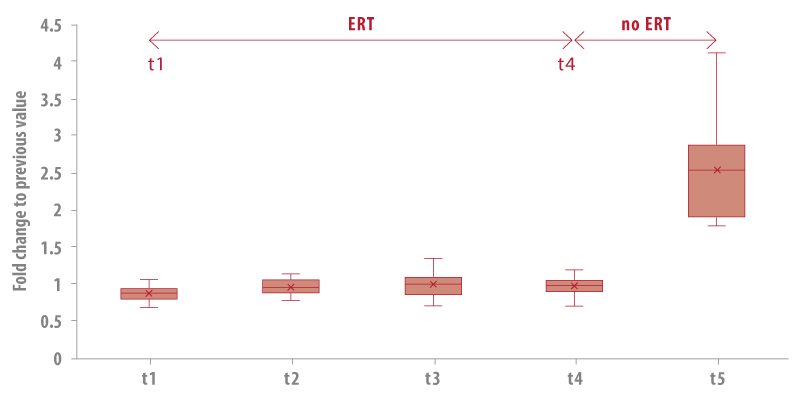
Lyso-Gb1 levels significantly and rapidly increase at time point t5 after a forced treatment break due to temporary unavailability of enzyme replacement therapy. Lyso-Gb1 thereby proves its superb capabilities for monitoring Gaucher disease.
1 Biomarker/Enzyme testing complementary to support the classification of unknown and pathogenic variants.
2 Wittmann, Judit, et al. „Newborn screening for lysosomal storage disorders in Hungary.“ JIMD Reports-Case and Research Reports, 2012/3. Springer, Berlin, Heidelberg, 2012. 117-125.
3 Burlina, Alberto B., et al. „Newborn screening for lysosomal storage disorders by tandem mass spectrometry in North East Italy.“ Journal of Inherited Metabolic Disease: Official Journal of the Society for the Study of Inborn Errors of Metabolism 41.2 (2018): 209-219.
4 Platt, Frances M., et al. „Lysosomal storage diseases.“ Nature Reviews Disease Primers 4.1 (2018): 1-25.
5 Elstein, Deborah, et al. „Reductions in glucosylsphingosine (lyso-Gb1) in treatment-naïve and previously treated patients receiving velaglucerase alfa for type 1 Gaucher disease: Data from phase 3 clinical trials.“ Molecular genetics and metabolism 122.1-2 (2017): 113-120.
MOx 2.0
All benefits and quality if CentoGenome in just 5 business days
Demonstrating the power of CENTOGENE’s multiomic approach for a fast and conclusive diagnosis
Mass spectrometry (MS) is a state-of-the art technique to identify and quantify lipid species. This study analyzed this tool to pave the way to better research and health outcomes for patients around the world.
An approach which integrates genetic and biochemical testing as first-line diagnostic tool for patients with inherited metabolic disorders.
Quantitation of a Urinary Profile of Biomarkers in Gaucher Disease Type 1 Patients Using Tandem Mass Spectrometry
Our global network of customer support and experts guiding you every step of the way.
Send us a messageRegional Support
