


Non-Invasive Prenatal Testing That Provides a Fast and Accurate Screen for the Most Common Prenatal Chromosomal Abnormalities.*
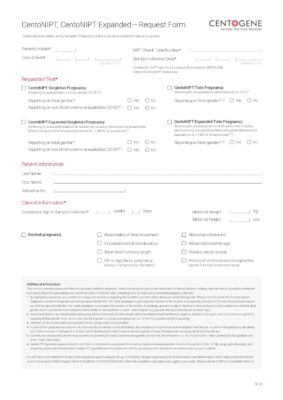
Get your results within 5 business days. CentoNIPT offers genetic, non-invasive prenatal testing (NIPT) to screen for the most common fetal chromosomal abnormalities.* Our test combines the latest next generation sequencing technology with expert medical reporting.
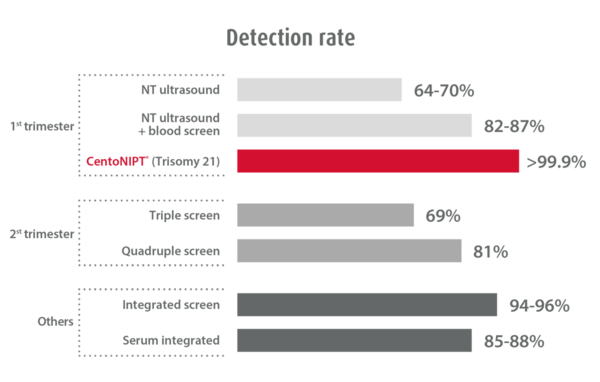
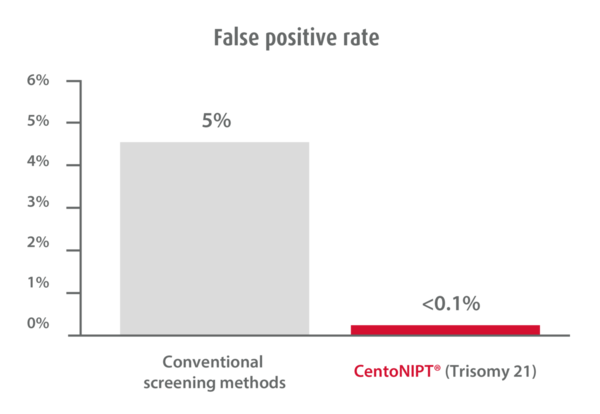
CentoNIPT is performed on a single maternal blood sample and combines the latest NGS technology with the highest quality medical reporting. It provides unparalleled accuracy and detection compared to other non-invasive testing methods – ultrasonography or nuchal translucency testing.
Our medical expertise is ideally suited to provide you and your patients with reliable, well supported interpretations of the results.
*Note: CentoNIPT is unavailable in the US.
New
CentoNIPT Expanded

Comprehensive reporting by our expert medical team

Test performed from the 10th gestational week

Highly accurate results available within 5 business days

CentoNIPT kit free of charge. Return shipment via phone call
Conventional prenatal testing for fetal chromosomal abnormality involves either chorionic villus sampling or amniocentesis. These procedures are highly invasive and carry an elevated risk of miscarriage. Despite this risk they are standard practice in most of the world because of their high levels of accuracy and the range of abnormalities they can detect.
Approximately 1 % of all babies will be born with a chromosomal abnormality which can cause physical disability andor mental retardation. Roughly 70 % of syndromic chromosomal abnormalities are due to Trisomies 21, 18, or 13 and 10 % due to Turner syndrome (Monosomy X). The risk of Trisomy increases significantly with maternal age.
| Common Autosomal Aneuploidies | Sensitivity | Specificity |
|---|---|---|
| Trisomy 21 Down syndrome | >99.9% | 99.9% |
| Trisomy 18 Edwards syndrome | >99.9% | 99.9% |
| Trisomy 13 Patau syndrome | >99.9% | 99.9% |
| Rare Autosomal Aneuploidies | Sensitivity | Specificity |
|---|---|---|
| Estimate % (n/N) | 96.4 % (27/28) | 99.80 % (2001/2005) |
| 2-sided 95% Cl | 82.3 %, 99.4 % | 99.49 %, 99.92 % |
| Rare Autosomal Aneuploidies Partial Deletions and Duplications (CNVs ≥7Mb) in Autosomes Rare Autosomal Aneuploidies | Sensitivity | Specificity |
|---|---|---|
| Estimate % (n/N) | 74.1 % (20/27) | 99.80 % (2000/2004) |
| 2-sided 95% Cl | 55.3 %, 86.8 % | 99.49 %, 99.92 % |
| Sex Chromosome Aneuploides & Fetal Gender | Concordance with cytogenetic results |
|---|---|
| XX | 100.0 % |
| XY | 100.0 % |
| X0 (Turner syndrome) | 90.5 % |
| XXX (Triple X syndrome) | 100.0 % |
| XXY (Klinefelter syndrome) | 100.0 % |
| XYY (Jacobs syndrome) | 91.7 % |
CentoNIPT is a screening test, designed to analyze chromosome aneuploidies of the fetus after 10 weeks of gestation. Reported are overrepresentations of chromosomes 13, 18 and 21, and optionally sex chromosome aneuploidies XO, XXX, XXY and XYY. Gender reporting can also be proactively selected.
Chromosome aneuploidies for a twin gestation can in general be detected by this test. However, the test cannot be attributed to individual twin fetuses. In twin pregnancies, sex chromosome aneuploidy reporting is not available and the test can only determine the presence of a Y chromosome; hence gender cannot be assigned to a specific twin.
Although CentoNIPT is a high accuracy screening test for the chromosome aneuploidies mentioned above, it cannot completely exclude the risk for these or aneuploidies in other chromosomes or other birth defects.
High risk for aneuploidy – if CentoNIPT identifies an aneuploidy (chromosome 13,18 or 21 or gonosomal chromosomes), CENTOGENE reports high risk for aneuploidy and provides data on fetal DNA fraction in the sample of mother´s peripheral blood (in percentages) and the data on fetal gender if requested. We urgently recommend to the referring physician or the genetic counselor to determine wether invasive testing and subsequent genetic analyses are needed.
Low risk for aneuploidy – if CentoNIPT did not indicate a trisomy of chromosome 13, 18, or 21 or gonosomal abnormalities, CENTOGENE reports low risk for aneuploidy together with the data on fetal DNA fraction and the data on fetal gender if requested. A negative result cannot entirely exclude the possibility of fetoplacental mosaicism. Thus, CENTOGENE is giving negative results of NIPT together with the suggestion: if the fetus shows abnormalities on ultrasound investigation, or if a family history of fetal abnormalities or other genetic disorders exists, we urgently recommend to the referring physician or the genetic counselor to consider whether invasive testing and subsequent genetic analyses are needed.
In the very unlikely case of unclear results of the non-invasive prenatal testing due to the limitation of the system, we recommend further follow-up of the fetal growth using ultrasound as well as 2nd trimester screens. In case of any abnormalities observed on the ultrasound examination or if there is a positive family history of fetal abnormalities or other genetic disorders, we urgently recommend to the referring physician or the genetic counselor to consider whether invasive testing and subsequent analyses are needed.
Sample Preparation and analysis software are CE-IVD marked
Noninvasive prenatal testing (NIPT) based on cell-free DNA analysis from maternal blood is a screening test; it is not diagnostic. Test results must not be used as the sole basis for diagnosis. Further confirmatory testing is necessary prior to making any irreversible pregnancy decision.


Do you already have a CentoNIPT box?
Prepare the maternal sample.

Select your test in CentoPortal by using the NI code on the streck tube provided.

Pack and ship the sample in your CentoNIPT box free of charge.
Sample processing and results within 5 business days.
This analysis is restricted to fetal cells from the placenta and not from the fetus itself. Fetoplacental mosaicism, a different chromosomal setup for placenta and fetus, is very rare but cannot be ruled out. Although sensitivity and specificity of NIPT are indeed high, it is necessary to confirm such results by additional method(s), such as echosonographic findings, maternal serum analysis; or perhaps amniocentesis for confirmation of a positive result.
Yes. The fetal fraction is included in the result.
Yes. However, the gender information will be provided only after 12 weeks of gestation, as regulated by German law, as the test is performed in Germany.
We report aneuploidy, the occurrence of additional chromosomes in the fetus. However, this analysis is restricted to those chromosomes where a living fetus could be born with abnormalities. These chromosomes include chromosome 13, 18, 21 and the sex chromosomes.
The analysis only reports if an additional chromosome has been identified
YES – the data indicate an extra copy of one chromosome. We urgently recommend to the referring physician or the genetic counselor to determine and decide if further invasive testing and subsequent analysis is needed.
NO – the data do not indicate any extra copy of the aforementioned chromosomes.
CentoNIPT is based on the in vitro diagnostic test Illumina VeriSeq™ NIPT Solution v2. This noninvasive IVD test utilizes whole-genome sequencing on cell-fetal DNA (cfDNA) fragments derived from maternal peripheral whole blood samples. After whole genome sequencing and bioinformatics analysis, chromosome read numbers and fetal fraction are combined and thus translated into chromosome ploidy. Finally, the comparison of the tested chromosomes by this test (21, 18, 13, X and Y) with reference chromosomes enables the identification of aneuploidies, which are then reported.
CentoPortal is an online ordering portal designed to assist you at every step of processing your patients’ samples.
Ten parental alleles in eight unrelated fetuses were diagnosed successfully based on the noninvasive method developed in this study. Read more!
We have explored a more efficient genetic screening strategy based on next-generation sequencing (NGS) of the CFTR gene. Read more!
This is the first case report in Oman and the Gulf region of a 17-β-hydroxysteroid dehydrogenase type 3 (17-β-HSD3) deficiency with a novel mutation in the HSD17B3 gene that has not been previously described in the medical literature.
Our global network of customer support and experts guiding you every step of the way.
Send us a messageRegional Support