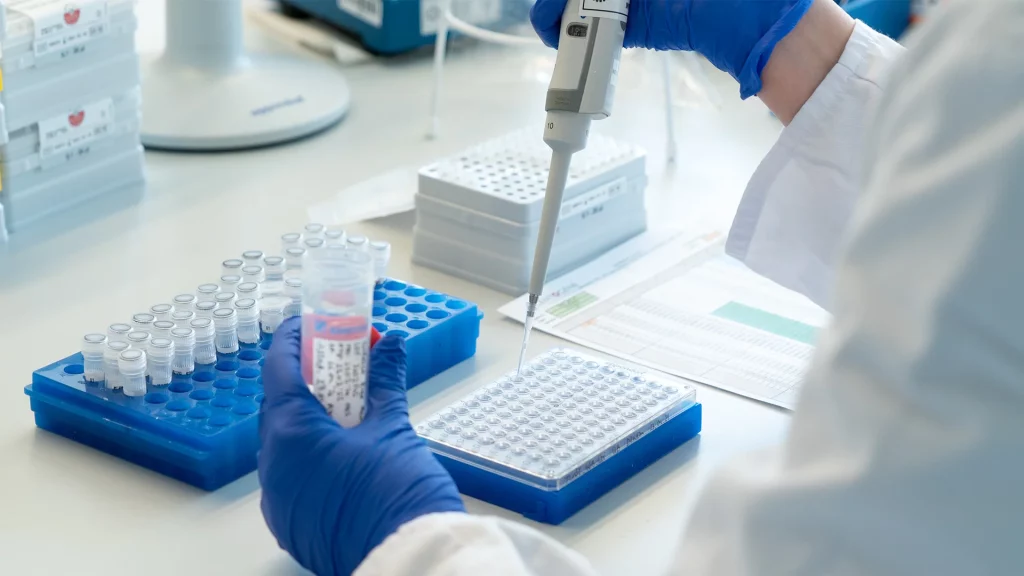
Whole Exome Sequencing (WES) is a comprehensive genetic test that identifies changes in a patient’s DNA that are causative or related to their medical concerns. By focusing on the entire protein-coding regions of the genome – the exome – WES offers you the coverage you need to diagnose patients rapidly and reliably.
Overcoming the Obstacles of Rare and Neurodegenerative Disease Diagnostics with CentoXome
With more than 7,000 identified rare diseases and approximately 80% being linked to genetic causes, diagnosing rare disease patients can often be difficult – resulting in lengthy, expensive, and emotional diagnostic odysseys.1,2
With WES, this doesn’t have to be the case. Containing the majority (~85%) of known disease-causing changes, WES uncovers the cause of rare diseases in less time and at a lower overall cost – leading to better patient outcomes. With CentoXome, we’ve taken WES to the next level. Enhanced to provide unparalleled clinical coverage and diagnostic power in a single test, our product design and medical interpretation utilize the world’s largest real-world data repository for rare and neurodegenerative diseases – the CENTOGENE Biodatabank.
The CentoXome design and service delivers ideal quality and performance from the world leader and trusted partner in rare and neurodegenerative disease diagnostics with outstanding clinical coverage and unmatched clinical diagnostic power in a single test. Coupling insights from the CENTOGENE Biodatabank for rare and neurodegenerative diseases with superior omics technology, you benefit from a solution that delivers a higher diagnostic yield compared to standard WES.3–12
| Key Features & Performance | |
|---|---|
| Broad and Uniform Exome & Mitochondrial Genome Coverage | Highly uniform coverage of the entire exome (~ 20,000 genes), +/- 10 bp exon-intron boundaries, and complete mitochondrial genome (37 genes)≥ 98 % target regions covered at ≥ 20x |
| Enhanced coverage of Clinically Relevant Regions | Enhanced coverage of disease-associated genes (OMIM®, HGMD®, CENTOGENE Biodatabank), with ≥ 99 % target regions covered at ≥ 20xCoverage of known clinically relevant variants in coding and non-coding regions (HGMD®, ClinVar, CENTOGENE Biodatabank) |
| Advanced and Sensitive Variant Detection | Detection of SNVs, InDels, SVs, including CNVs of exon-level to cytogenomic-level changes, and mtDNA with heteroplasmy ≥ 15 %SensitivitySNVs and InDels (≤ 50 bp)> 99.6 %CNVs*> 95.0 %Specificity of > 99.9 % is guaranteed for all reported variants**UPD detection*** for the well-known clinically relevant chromosomal regions: 6q24, 7, 11p15.5, 14q32, 15q11q13, 20q13, and 20 |
SNVs: single nucleotide variants; InDels: small insertions/deletions; CNVs: copy number variations; UPD: uniparental disomy; mtDNA: mitochondrial DNA.
* CNV detection software sensitivity > 95 %; however, this sensitivity may be decreased for repetitive and homologous regions, such as pseudogenes, as well as for events spanning two or fewer exons.
** Variants with low quality and/or unclear zygosity are confirmed by orthogonal methods: SNVs and InDels by Sanger sequencing; CNVs by Multiplex ligation-dependent probe amplification (MPLA), quantitative polymerase chain reaction (qPCR) or chromosomal microarray (CMA).
*** Screening of UPD is performed using an in-house algorithm for Mendelian Inheritance Errors (MIE) to detect runs of homozygosity (ROH) for the well-known clinically relevant chromosomal regions. Guaranteed internal confirmatory testing using CMA when necessary.

CentoXome offers a rapid and cost-effective solution for diagnosing rare and neurodegenerative diseases, serving as both a first-line and second-line test to identify molecular diagnoses in patients with suspected genetic disorders or negative results from prior genetic testing.3, 5, 11 Moreover, it may provide a cost-effective alternative to multiple independent molecular assays, thereby streamlining the diagnostic process.
WES has traditionally been recommended when patients present with complex, heterogeneous phenotypes suggestive of multiple conditions or when prior genetic testing has been inconclusive. Its utilization in clinical practice has significantly increased in recent years, surpassing standard genetic tests such as single genes, NGS panels, and chromosomal microarray analysis.4, 10, 13–15 Additionally, there is growing evidence of the economic value of using WGS/WES as a first-line test.16–18 Guidelines from the ACMG (American College of Medical Genetics and Genomics) and other medical societies recommend exome/genome sequencing as a first- or second-line diagnostic test when a patient’s symptoms or family history suggest a genetic cause of the diseases.19–22 Furthermore, test results from WES may lead to more rapid diagnoses, improved prevention of symptomatic illness, more targeted treatments, or even eliminate the need for some costly or invasive procedures.10 ,14, 15, 19, 23
We particularly recommend CentoXome for patients when:
We offer flexible testing options and additional services to provide a CentoXome analysis tailored to your patient’s needs, such as, for example, WES for ongoing pregnancies with fetal abnormalities for prenatal diagnostics (CentoXome Prenatal), and our multiomic WES solutions (CentoXome MOx 1.0 and 2.0) integrate different data sets, serving as highly effective tools for the early diagnosis of rare and neurodegenerative diseases.
Committed to improving the lives of patients with rare and neurodegenerative diseases, CentoXome is paired with life-long diagnostic support via a free-of-charge and proactive reclassification program, as well as an affordable case-level reanalysis in case of uncertain or negative results. WES diagnostic yield is continuously increasing due to the rapid rate of new gene-disease discoveries, and it is estimated that about 10–20% of undiagnosed patients can be diagnosed by reclassification and genomic data reanalysis.15, 24
| Options & Additional Services | |||
|---|---|---|---|
| Testing Design* | Solo, Duo, Trio, and PLUSMitochondrial genome analysis is performed only for the index patient and maternal samples | ||
| Testing Solutions | CentoXome | WES for postnatal diagnostic testing of rare and neurodegenerative diseasesTAT: ≤ 30 business days | |
| CentoXome MOx** | Multiomics single-test solutions integrating WES with biochemical testing and/or RNA-seq for splicing variantsCentoXome MOx 1.0 and 2.0 for postnatal testing of rare and neurodegenerative diseasesCentoXome MOx 1.0 TAT: ≤ 30 business daysCentoXome MOx 2.0 TAT: ≤ 35 business days | ||
| CentoXome Prenatal*** | WES for prenatal diagnostics (ongoing pregnancy) when fetus structural abnormalities are detected on ultrasound, or a diagnosis cannot be obtained using routine prenatal methodsExpedited and prioritized testing and includes cell culture and maternal cell contamination (MCC) analysisTAT: ≤ 15 business days | ||
| CentoXome POC*** | WES for diagnostic testing of product of conception (pregnancy loss) in cases of intrauterine fetal demise or stillbirth to better understand cause of fetal loss and risk for recurrence, or when a diagnosis cannot be obtained using routine methodsIncludes cell culture and MCC analysisTAT: ≤ 30 business days | ||
| CentoXome Variants | WES raw and processed data (files in FASTQ, BAM and VCF format along with filtered and annotated variant files in XLS format) for further research availableFree of charge for download via CentoPortal for a period of 30 daysTAT: ≤ 20 business days | ||
| Additional Options | FAST Processing | ≤ 15 business days (not applicable with CentoXome MOx 2.0) | |
| Free of Charge Raw Data | For all testing solutions accompanied by medical reports, both raw and processed data are available as options. These data include files in FASTQ, BAM, and VCF formats, as well as a filtered and annotated variant file in XLS format.This data can be downloaded via CentoPortal free of charge for a period of 30 days | ||
| Life-long diagnostic support**** | Proactive variant-level reclassification; reclassification report issued at no extra costCase-level reanalysis for uncertain/negative results (e.g., new clinical information, one-year intervals) at an affordable cost | ||
TAT: Turnaround time
* Solo: only affected index patient is tested; Duo: index patient and affected or unaffected family member are tested; Trio: index patient and two family members, affected or unaffected are tested; PLUS: additional family member beyond Trio is tested.
** More details about our Multiomic Solutions.
*** WES-based mitochondrial genome analysis and screening for UPD is not offered due to technical limitations. More details about Prenatal Testing.
**** Case reanalysis is available only for orders with original sequencing data from August 2020 onwards. More details about Variant Reclassification Program.

When choosing our WES, physicians, patients, and partners can feel confident that they will receive high-quality sequencing combined with best data analysis and interpretation, documented in comprehensive medical reports. By combining deep phenotype data with genotype data using our CE-IVD bioinformatics pipeline, CENTOGENE accurately identifies disease-causing variants to deliver best-in-class clinical reporting.
CentoXome always includes medical reporting based on our clinical interpretation expertise, best-in-class curated variant data from our Biodatabank, and international best-practice guidelines. A team of highly trained clinical geneticists and scientists interpret the data and cross-check every medical report. All historical high-quality classifications are curated and codified in our Biodatabank, which is a reference for diagnostic decisions and classifications.
Test reports always contain clear actionable clinical results, recommendations, and follow-up options. They are phenotype-driven and focused on reporting findings related to the patient’s clinical presentation/patient’s indications.
For more information, please consult the Medical Reporting webpage .

Immune dysregulation caused by homozygous mutations in CBLB
Further clinical and genetic evidence of ASC-1 complex dysfunction in congenital neuromuscular disease
Alternative splicing of BUD13 determines the severity of a developmental disorder with lipodystrophy and progeroid features
Our global network of customer support and experts guiding you every step of the way.
Send us a messageRegional Support1RARE Facts – Global Genes; 2NIH Genetics and Rare Disease (GARD); 3Cheema et al. 2020, PMID: 33083013; 4Clark et al. 2018, PMID: 30002876; 5Data on file at CENTOGENE; 6Gross et al. 2018, PMID: 30293986; 7Posey et al. 2019, PMID: 31234920; 8Schon et al. 2020, PMID: 32674947; 9Scuffins et al. 2021, PMID: 33495530;10Stark et al. 2016, PMID: 26938784;11Trujillano et al. 2017, PMID: 27848944;12Wagner et al. 2019, PMID: 31059585; 13Srivastava et al. 2019, PMID: 31182824; 14 Smith. et al.2019, PMID: 29760485; 15 Vissers et al. 2017, PMID: 28333917; 16 Bowling et al. 2017, PMID: 28554332; 17 Malinowski et al. 2020, PMID: 32203227; 18 Trosman et al. 2020, PMID: 31501586); 19 Manickham et al. 2021, PMID: 34211152; 20 Matthijs et al. 2016, PMID: 2762856; 21 Souche et al. 2022, PMID: 35577938; 22 Boycott et al. 2015, PMID: 25951830); 23 Liu et al. 2019, PMID: 31216405; 24 Wright et al. 2018, PMID: 29323667; 25Clinical Genome Resource. www.clinicalgenome.org; 26 Miller et al. 2021, PMID: 34012069; 27 Richards et al. 2015, PMID: 25741868.